Feature Article
A word from Dr. Robert Leverence, UT Health San Antonio, Chief Medical Officer
 

"This has been a chaotic and confusing time, especially for primary care practices and many other branches of medicine. We understand what your practice may be going through and we want to be a resource to get through these uncertain times.  We are here to help; our practice is open and our specialists are seeing many patients via telemedicine/video visits and in the office when necessary. There is light at the end of this tunnel, and we hope to come out of this better and stronger as an organization and individuals. I look forward to the time when we can meet in person again."


COVID-19 Video Update
 

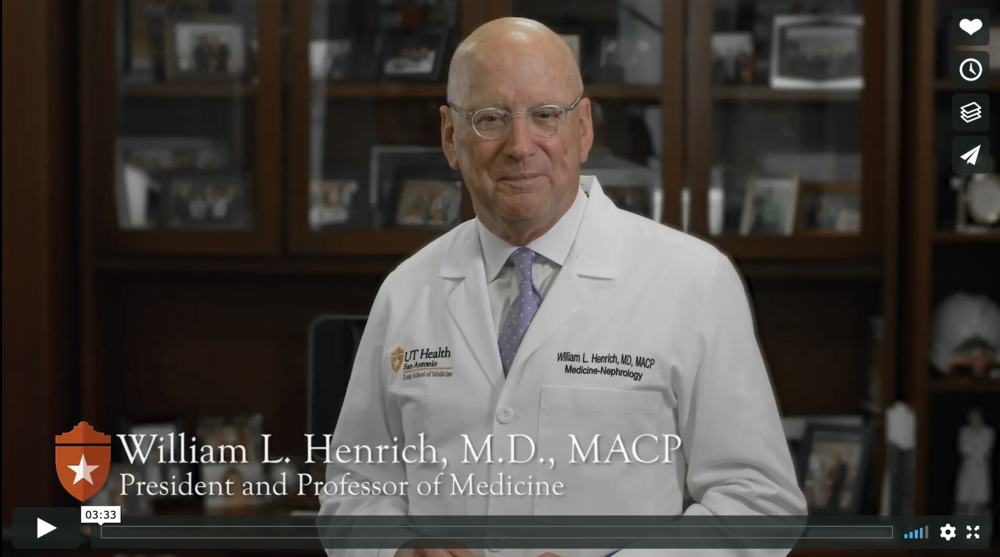
William L. Henrich, M.D., MACP, president UT Health San Antonio, speaks to our efforts to confront the COVID-19 pandemic, from providing front-line health care workers who are screening and caring for COVID patients, to working to advance testing technology and fast-track treatments.


Access to UT Health Providers

UT Health Physicians is open and seeing patients. We will continue to accept referrals during the public health emergency.  Please continue to refer to UT Health Physicians as you have been for specialist referrals.  When possible, it is recommended that referrals are sent through EpicCare Link


Additional information: 

•Visitors are not allowed to accompany patients to their  Patients who require medical assistance to attend their appointment may be accompanied by one healthy adult.
•While in our offices, patients over the age of two should wear a face covering or mask.
•We are screening all who enter our facilities for symptoms, which includes taking their temperature.  We also are screening staff and providers before anyone can enter the building.
•If a patient has had cold or flu-like symptoms, call to inform the care team before arriving at the appointment.
•We are now offering video visits through our MyChart online portal
•We are postponing some elective procedures and follow-up visits when it is safe to do so


UT Health Physicians telehealth visits

Telehealth Expansion/Coverage

Effective for services starting March 6, 2020, and for the duration of the COVID-19 Public Health Emergency, Medicare will make payments for Medicare telehealth services furnished to patients in broader circumstances. This includes professional services furnished to beneficiaries in all areas of the country in all settings, including patients’ homes. These visits are considered the same as in-person visits and are paid at the same rate as regular, in-person visits.


List of Covered Telehealth Services during Public Health Emergency effective 3/1/2020: Link

American College of Physicians Telehealth Summary: Link

CMS Telehealth Provider Fact Sheet (3/17/2020): Link

Novitas Billing for Professional Telehealth Services During the Public Health Emergency: Link


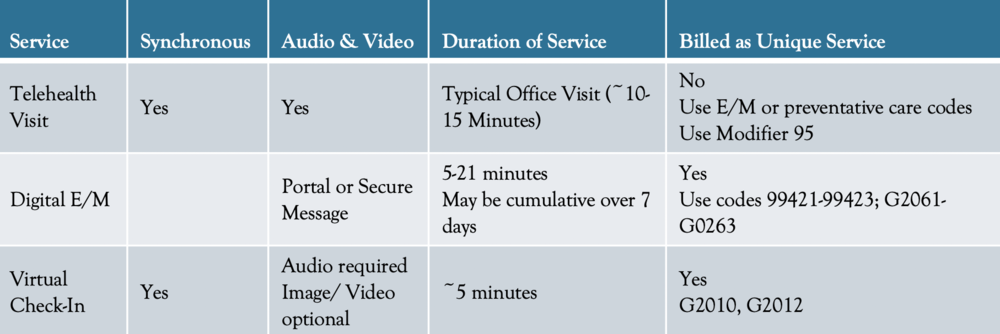
Summary of Telemedicine Services:


Will CMS telemedicine reimbursement regulations apply only to COVID-19 related billings/visits, or will providers really be able to use them for AWVs/TCMs/E&Ms for healthy patients?

The recently passed legislation relaxing telehealth requirements is not limited to COVID-19 billings/visits. For the exact reason of limiting exposure and impact on the healthcare system, we would encourage any visit that can be safely and effectively done via telehealth to convert to telehealth during the public health emergency.


Are telephone and telehealth visits the same?

•Telehealth visits require video and audio communication between a patient and a healthcare provider.

•Telephone only (no video) are reimbursable by Medicare as well as many private payers during this public health emergency

  -No modifier is needed for these codes because they are not telehealth – they are audio only telephone.

  -Use your normal Place of Service.  For instance, POS=11 (private practice).

  -Can be used for new or established patients.

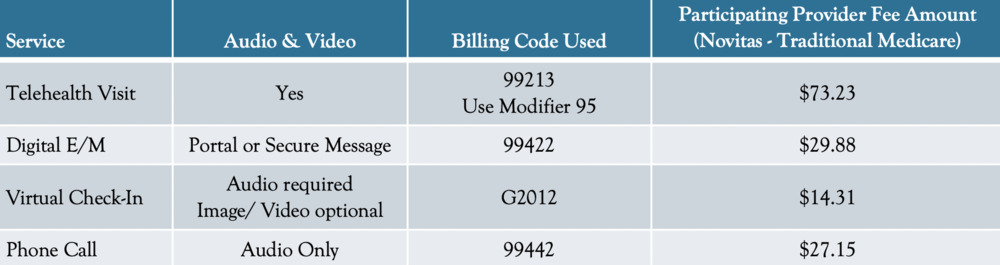
•Telephone only visits are reimbursed at a much lower rate than telehealth visits (video and audio).

Novitas Fee Lookup: Link


What does Medicare pay for telehealth today?

Medicare will pay the distant site practitioner (i.e. the one doing the CPT-described service) the facility rate for the service. Facility rates can be found in the physician fee schedule lookup tool. Physician offices should use Modifier 95. Link

Novitas Medicare Physician Fee Schedule: Link


Are Virtual Check-Ins, Online Digital E/M and Telehealth visits reimbursed the same?

•Telehealth visits (audio and video) intended to be similar to a traditional office visit with technology support. Telehealth services are reimbursed like a normal clinic encounter.


Medicare approved Telehealth Services: Link


What if all the services of the CPT code cannot be accomplished?

The law did not contemplate modifications to CPT codes and CMS has yet to issue guidance on implementation. Unless they do so, we assume all requirements are necessary to bill the code. Telehealth normally requires a patient to go to another health care facility where things like BP and weight can be taken. When the originating site is the home, the lack of certain capabilities may prevent certain codes from being performed even though they are on the telehealth list.


Can I use consumer audio/video communication like FaceTime or Skype?

Yes, the HHS Office of Civil Rights (OCR) issued a notice that specifically allows for use of private consumer technologies. However, purpose-built telehealth tools have many features such as billing assistance, consent management, waiting rooms, etc. that are not available in consumer technologies. If you use consumer technology, you need to ensure all state-required mandates are met, including requirements for patient consent The only thing the waiver does is waive enforcement of the privacy and security requirements of the technology itself.

Additional HIPAA Telehealth HHS Information: Link


Is it only available for established patients?

The federal legislation required physicians to have an established relationship with a patient in order to use these new flexibilities, but CMS has said “HHS will not conduct audits to ensure that such a prior relationship existed for claims submitted during this public health emergency.”  This means that the “established relationship” federal requirement essentially does not apply in the current environment.  Link


Additional Information:

AAFP Telehealth Toolkit: Link

Information on skilled nursing facility and home health telehealth services: Link

CARES Act - COVID-19 Small business stimulus

On March 27, President Trump signed the Coronavirus Aid, Relief and Economic Security (CARES) Act, into law.


On March 27, President Trump signed the Coronavirus Aid, Relief and Economic Security (CARES) Act, into law. The stimulus package includes over $2 trillion in spending and tax relief to assist the American public and healthcare providers responding to the COVID-19 pandemic. Link


The CARES Act provides direct support for healthcare providers and organizations in several ways including:

•Expanding Medicare Telehealth Flexibilities (Section 3703)

•Enabling Physician Assistants and Nurse Practitioners to order medical home health services (Section 3708)

•Increased provider funding through immediate sequestration relief (Section 3709)

•Expanded list of over-the-counter medical product that can be purchased using HSAs and Flexible Spending Accounts (Section 3702)

•Access to Medicare Advance and Accelerated Payments for Physicians (Section 3719)

•Increased reimbursement for hospitals treating COVID-19 patients (Section 3710)

•Allow 3-Month fills and refills of covered Medicare Part D drugs (Section 3714)


The CARES Act also provides relief for small businesses through:

•Paycheck Protection Program supporting loans and grants (Section 1102) Link

•Delayed payment of employer payroll taxes (Section 2302)


Paycheck Protection Program supporting loans and grants (Section 1102) Link

What’s In It for Businesses?

•All businesses, regardless of size, are eligible for a 50% refundable payroll tax credit

•The credit is applied toward the first $10,000 of an employee’s wages

•The business must demonstrate a 50% reduction in receipts compared to the same quarter in 2019

•Employers’ portion of the Social Security payroll tax can be delayed until Jan. 1, 2021


Small Businesses

•The $350 billion Paycheck Protection Program lends up to $10 million to small businesses with fewer than 500 employees.  The loan amount is tied to payroll  costs.  It covers employees making up to $100,000 a year.

•The loan program is for payroll and other expenses between Feb. 15 and June 30, 2020.  Loans may be forgiven if used for payroll, mortgage interest payments, rent, and utilities. 

•Contact the Small Business Administration, which also has other loan programs and resources to help small businesses through the pandemic.

•Paycheck Protection Program FAQs: Link


Access to Medicare Advance and Accelerated Payments for Physicians (Section 3719)

What are accelerated/advance payments?

An accelerated/advance payment is a payment intended to provide necessary funds when there is a disruption in claims submission and/or claims processing. These expedited payments can also be offered in circumstances such as national emergencies, or natural disasters in order to accelerate cash flow to the impacted healthcare providers.


Is my practice eligible for accelerated/advance payments?

Providers must:

•Have billed Medicare for claims within 180 days immediately prior to the date of signature on the provider’s/supplier’s request form,

•Not be in bankruptcy,

•Not be under active medical review or program integrity investigation, and

•Not have any outstanding delinquent Medicare overpayments.


How much am I eligible to receive?

Qualified providers will be asked to request a specific amount using an Accelerated or Advance Payment Request form provided on each MAC’s website (Novitas). Most providers will be able to request up to 100% of the Medicare payment amount for a three-month period.


How does the recoupment or repayment work?

The provider can continue to submit claims as usual after the issuance of the accelerated or advance payment; however, recoupment will not begin for 120 days. Providers will receive full payments for their claims during the 120-day delay period. At the end of the 120-day period, the recoupment process will begin and every claim submitted by the provider will be offset from the new claims to repay the accelerated/advanced payment.


Where can my practice apply?

Texas based providers should apply through Novitas. Link

COVID-19 Frequently Asked Questions:

Find the answers to your most common questions.


What if I do not offer COVID-19 testing in my clinic, what resources are available?

•If you are not offering COVID-19 testing in your clinic patients can be tested by the San Antonio Metropolitan Health District testing.  Link

•The phone number for providers to contact the Metro Health COVID-19 Testing Hotline: 210.207-8876

•Phone number available for general COVID-19 Questions: 210.207.5779

•Patients do not need an order for the Metro Health’s testing


Can a collected specimen be sent to Metro Health’s COVID-19 Testing Center?

•Yes, please review the following  tip sheet: Link

•Interim Criteria for Metro Health COVID-19 Testing: Link

•The phone number for providers to contact the Metro Health COVID-19 Testing Hotline: 210.207-8876

•CDC tips for prioritizing patients for testing: Link


What if I need to care for someone with the virus?

Limit exposure to the infected person by using a mask and gloves when you must be closer than 6 feet. After tending to the ill individual, dispose of the mask and gloves and institute good hand washing hygiene and disinfecting all items that the infected person came in contact with.

Use protective measures including social distancing, hand washing, cleaning and disinfecting, gloves, mask.

Additional tips from the CDC: Link


What is the best way to clean and disinfect against COVID-19?

•Use a common EPA-registered household disinfectant that is appropriate for the surface you are cleaning. See Disinfectants for use against COVID-19: Link

•Other options include:

  -Diluting household unexpired bleach

   -5 TBSP (⅓ c) bleach per gallon of water

   -4 Teaspoons bleach per quart of water

•Alcohol solutions of at least 70% alcohol


What are the most common symptoms of the disease?

•Symptoms can vary from person-to-person but these symptoms may appear 2-14 days after exposure:

•Fever, Cough, and Shortness of breath

•Emergency warning signs that require medical attention include:

•Difficulty breathing or shortness of breath

•Persistent pain or pressure in the chest

•New confusion or inability to arouse

•Bluish lips or face

•CDC COVID-19 symptoms: Link


Is there a way to self-screen for COVID-19?

Although the Corona Virus must be confirmed by test, San Antonio Metropolitan Health Department has provided a self-screening tool: Link


How should a person track symptoms at home?

•Two times a day (morning and night), write down your temperature and any COVID-19 symptoms you may have: feeling feverish, coughing, or difficulty breathing. Do this every day for 14 days.

•Fill in the dates on the log, starting with Day 0 and ending with Day 14. Day 0 is the day you left the country with an outbreak of COVID-19.

•Start recording your temperature and symptoms, beginning with today’s date. Fever is 100.4°F/38°C or higher.

•14 day tracking form: Link

•Additional CDC guidance on tracking symptoms: Link


Should I wear a mask?

To help slow the spread of COVID-19, the City of San Antonio recommends that all people over the age of 5 years should wear a cloth face covering over their nose and mouth when in a public place where it is difficult to stay six feet away from others. This is in line with guidance from the Centers for Disease Control & Prevention (CDC) released on April 3. Residents must continue social distancing while outside their home performing essential activities, as outlined in the Mayor’s Stay Home Work Safe Order Link


How can I make a cloth face cover or mask?

CDC Guidance on do it yourself masks: Link


How can I stay well in public places?

•It is recommended to over your mouth and nose with a cloth face cover when around others: Link

•Everyone should wear a cloth face cover when they have to go out in public, for example to the grocery store or to pick up other necessities

  -Cloth face coverings should not be placed on young children under age 2, anyone who has trouble breathing, or is unconscious, incapacitated or otherwise unable to remove the mask without assistance

 -The cloth face cover is meant to protect other people in case you are infected

•Continue to keep about 6 feet between yourself and others. The cloth face cover is not a substitute for social distancing

•Additional CDC Tips: Link


How do I determine how soon I will exhaust my PPE supply?

The CDC has developed a PPE burn rate calculator: Link


Can I have a clinical staff member contact my patients by phone through Chronic Care Management?

•Chronic Care Management can be an effective way to support at-risk patients with multiple chronic conditions telephonically using a standard care plan.

•Chronic care management services, at least 20 minutes of clinical staff time directed by a physician or other qualified health care professional, per calendar month.

•CMS Chronic Care Management MLN: Link

•For additional information on Chronic Care Management, contact Adam Kirking at kirking@uthscsa.edu